


Vibrant Villages Programme–II (VVP-II)
Syllabus: GS2/ Governance
In News
- The Vibrant Villages Programme–II (VVP-II) is a Central Sector Scheme launched by the Union Home Minister at Nathanpur village in Assam’s Cachar district.
About
- VVP-II aims to fill infrastructure gaps, reverse out-migration, and improve livelihoods in border areas, fostering secure communities aligned with Viksit Bharat 2047.
- It builds on VVP-I by targeting comprehensive development in border villages along India’s international land borders (excluding northern borders covered earlier), spanning 15 states and 2 UTs with a ₹6,839 crore outlay until FY 2028-29.
- Evolved from the 1986-87 Border Area Development Programme (BADP), VVP-I (2023) targeted northern borders; VVP-II extends to Indo-Bangladesh, Indo-Nepal, Indo-Myanmar, Indo-Bhutan, and Indo-Pakistan frontiers with tailored strategies.
Key Features
- Saturation approach: Ensures all households access existing welfare schemes via convergence.
- Core infrastructure: Prioritizes all-weather roads (PMGSY-IV), telecom (Digital Bharat Nidhi), TV connectivity (BIND), and electrification (RDSS).
- Livelihood focus: Promotes value chains through cooperatives/SHGs, tourism, education (e.g., SMART classes), and cultural events.
Source: PIB
Trump’s Board of Peace
Syllabus: GS2/ IR
In News
- India participated as an observer in the recent inaugural meeting of US President Donald Trump’s Board of Peace on Gaza, held in Washington DC and hosted at the Donald J Trump Institute of Peace.
About the Board
- Established in January, 2026, in Davos, the Board stems from Trump’s 20-point peace plan for Gaza, endorsed by UN Security Council Resolution 2803, which facilitated a ceasefire in the Israel-Hamas conflict.
- The Board aims to demilitarize Gaza, oversee reconstruction (estimated at $70 billion), and stabilize the region through aid, Hamas disarmament, and Israeli troop withdrawal.
Source: TH
“Bio-AI Mulankur” Hubs
Syllabus: GS3/ S&T
In News
- Dr. Jitendra Singh, India’s Science and Technology Minister, announced plans to establish Bio-AI Mulankur hubs during recent events tied to the India AI Impact Summit.
About
- These hubs create closed-loop platforms integrating AI predictions with lab validation and data analytics.
- They target genomics diagnostics, biomolecular design, synthetic biology, and Ayurveda research to drive scalable biotech solutions.
- The initiative supports the BioE3 Policy, promoting biotechnology for environment, economy, and employment through high-performance biomanufacturing.
- It builds on DBT’s Bio-RIDE scheme, emphasizing AI-biotech convergence for health, agriculture, and environmental gains.
Source: PIB
Bharat GI
Syllabus: GS3/ Economy
In News
- ‘Bharat GI’, a national initiative to promote India’s Geographical Indication-tagged products globally, was highlighted at the India AI Impact Summit 2026.
About
- Bharat GI serves as an umbrella brand showcasing unique Indian GI products like Coorg coffee and Darjeeling tea on international platforms.
- It is launched by the Department for Promotion of Industry and Internal Trade (DPIIT), Ministry of Commerce.
- It leverages digital tools, including AI-driven traceability and market analytics, to connect artisans directly with global buyers.
Source: PIB
ETFs (Exchange-Traded Funds) Surged
Syllabus: GS3/Economy
In News
- According to data from the World Gold Council, India’s gold ETFs bought a record 15.52 tonne of gold in January, almost equal to the demand seen in the previous three months combined.
ETFs (Exchange-Traded Funds)
- They are investment funds traded on stock exchanges that hold a mix of assets like stocks, bonds, or commodities.
- They let investors easily buy a diversified portfolio, track a specific index or sector, and offer cost-effective exposure to various markets, with prices fluctuating throughout the trading day.
Types
- Equity ETFs – invest in stocks, track indices like S&P 500 or sector-specific indices.
- Bond ETFs – invest in government or corporate bonds, offering stability and fixed income.
- Commodity ETFs – mainly gold in India, providing exposure to commodities and hedging against inflation.
- Currency ETFs – track specific currencies globally but limited in India.
Benefits
- ETFs offer diversification across assets, are cost-effective with lower fees
- They provide high liquidity as they trade like stocks, ensure transparency with daily disclosure of holdings
- They are generally tax-efficient compared to mutual funds.
Issues
- ETFs can incur trading costs like commissions, carry an overtrading risk due to ease of buying and selling,
- They may experience tracking errors, where their performance slightly deviates from the underlying index.
Developments
- Rising gold and silver ETF investments in January pushed India’s goods trade deficit to $35 billion, as households, still wary of formal savings, turned to metals amid volatility and geopolitical uncertainty.
- Earlier Sovereign Gold Bonds helped curb imports but were discontinued in 2024 due to high costs, prompting calls for a new scheme for gold, silver, and other metals.
Source :IE
India–UK Offshore Wind Taskforce
Syllabus: GS2/IR
In News
- India and the United Kingdom launched the India–UK Offshore Wind Taskforce.
India–UK Offshore Wind Taskforce
- It has been constituted under Vision 2035 and the fourth India–UK Energy Dialogue to provide strategic leadership and coordination for building India’s offshore wind ecosystem.
- It is aimed at accelerating cooperation in offshore wind development as part of their broader clean energy partnership under Vision 2035.
- Focus areas for cooperation are ecosystem planning and market design, including seabed leasing frameworks and revenue certainty mechanisms.
Importance
- Offshore wind can supply high-quality renewable power to coastal industrial and green hydrogen clusters, strengthening industrial competitiveness and energy security.
- India–UK Offshore Wind Taskforce reflects mutual confidence between India and the UK to address execution challenges in offshore wind development.
- The UK brings experience in scaling offshore wind and developing mature supply chains, India offers scale, long-term demand and a rapidly expanding clean energy market.
Do you know?
- India’s installed non-fossil fuel capacity has crossed 272 GW, including over 141 GW of solar and 55 GW of wind capacity.
- During the current financial year, India has added more than 35 GW of solar and 4.61 GW of wind capacity.
- India is leading the Hydrogen Breakthrough Goal under the international Breakthrough Agenda and has achieved globally competitive benchmarks under the National Green Hydrogen Mission, with green hydrogen prices falling to a historic low of ₹279 per kg (approximately £2.65 per kg) and green ammonia prices reaching ₹49.75 per kg (approximately £0.47 per kg).
Source :PIB
Bihar’s Ban on Open Sale of Meat
Syllabus: GS2/Governance; Health
Context
- The Bihar government announced a ban on open-air and unlicensed meat sales in urban areas.
About
- It prohibits the sale of meat and fish in open spaces, such as roadsides, weekly markets or public thoroughfares, within urban municipal areas.
- Sales are now restricted to licenced shops that comply with hygiene standards such as proper waste disposal.
- Violations can attract penalties under the Bihar Municipal Act, 2007, including fines, seizure of goods and shop closures.
- Rational: Open-air vending poses serious public health risks, particularly in Bihar’s humid climate.
- Unrefrigerated meat attracts flies, dust and pests, increasing contamination by pathogens like salmonella, E. coli, and listeria.
- Waste such as blood, feathers and offal often clogs drains.
- Legality: The Bihar Municipal Act, 2007, empowers municipalities to impose conditions on hygiene, waste management, location and supervision.
- Other States: Many states have regulations calling for licensed and enclosed sale of meat and fish.
- These states include Uttar Pradesh, Assam, and Jharkhand.
- States such as Odisha, Himachal Pradesh, Karnataka and Maharashtra have imposed localised restrictions, such as near temples during festivals or in pilgrim towns.
Source: IE
Loggerhead Turtles
Syllabus: GS3/Species in News
Context
- According to a recent study, warmer oceans and declining food availability are affecting the reproductive and migratory patterns of loggerhead turtles.
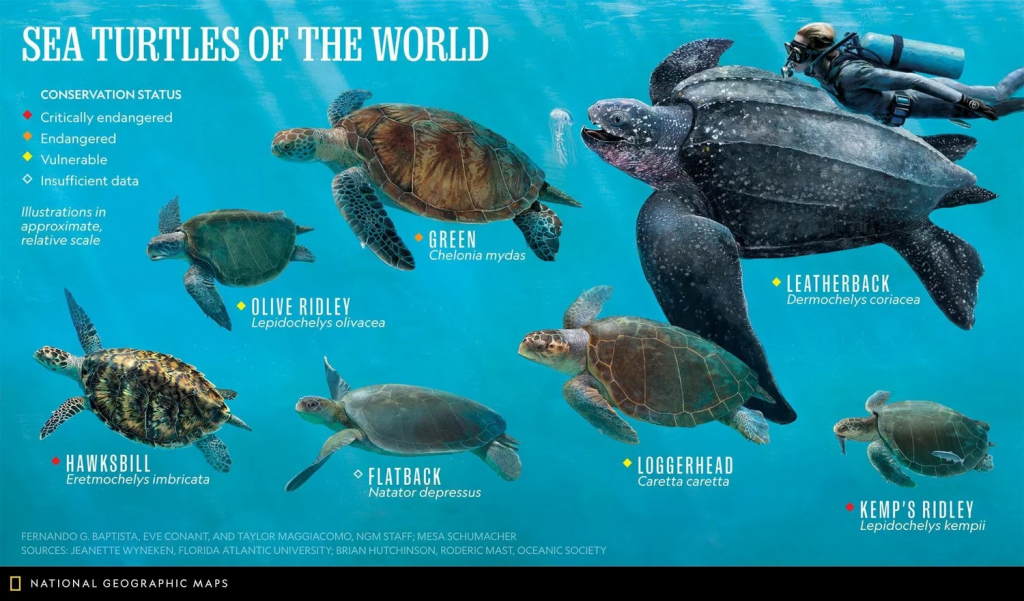
Loggerhead Turtles (Caretta caretta)
- The loggerhead turtle is named for its large head, which supports powerful jaw muscles that enable them to feed on hard-shelled prey, such as whelks and conch.
- They are found across the Caribbean region, Atlantic Ocean, the eastern Mediterranean Sea, the Indian Ocean and the North and South Pacific Oceans.
- The Loggerhead sea turtle is a large omnivorous marine reptile recognized as one of the seven extant species of sea turtles.
- They can live up to 80 years or more.
- Threats include bycatch in fishing gear, direct harvest of turtles and eggs, loss and degradation of nesting habitat, and changing environmental conditions.
- They are classified as Vulnerable by the International Union for Conservation of Nature (IUCN).
Source: TH
Previous article
ISA Launches Global AI-for-Energy Mission
